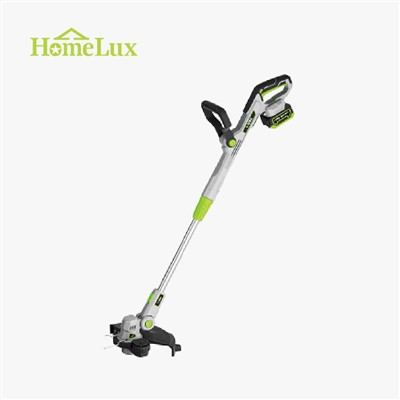
Hey there! I'm a supplier of Brushless Cordless String Trimmer. Today, I wanna share with you how I test the functionality of a new brushless cordless string trimmer.
Initial Checks
Before we dive into the actual performance testing, there are some initial checks that I always do. First off, I take a good look at the physical appearance of the trimmer. I check for any visible damages, like cracks on the body or bent parts. A damaged trimmer can not only affect its performance but also pose a safety risk.
Next, I inspect the battery. It's the power source of our cordless trimmer, so it's crucial. I make sure the battery is properly seated in its compartment and that the contacts are clean. Any dirt or debris on the contacts can lead to a poor connection and reduce the battery's efficiency. I also check the battery indicator if it has one. A fully charged battery is essential for accurate testing.
Power and Motor Performance
Once the initial checks are done, it's time to test the power and motor performance. I turn on the trimmer and listen to the motor. A healthy brushless motor should run smoothly and quietly. Any strange noises, like grinding or rattling, could indicate a problem with the motor.
I also pay attention to the startup time. A good trimmer should start up quickly without any hesitation. If it takes a long time to start or needs multiple attempts, that's a red flag.
To really test the power, I use a piece of thick grass or small branches. I guide the trimmer through them and see how well it cuts. The trimmer should be able to cut through the grass or branches effortlessly. If it struggles or the cutting speed slows down significantly, the motor might not be powerful enough.


Cutting Performance
Cutting performance is one of the most important aspects of a string trimmer. I test the cutting width first. A wider cutting width means you can cover more ground in less time. I measure the effective cutting width using a ruler and compare it with the specifications provided by the manufacturer.
Then, I test the cutting efficiency. I set up a small area with different types of grass, including thick and thin ones. I run the trimmer over the grass and observe how cleanly it cuts. The line should cut through the grass evenly without leaving any uncut patches. If the grass is torn or frayed instead of being cleanly cut, the cutting line might be dull or not properly installed.
I also test the trimmer's ability to cut at different angles. A good trimmer should be able to cut at various angles, which is useful for trimming around obstacles like trees or flower beds. I tilt the trimmer at different angles and see if it can still cut effectively.
Ergonomics and Handling
A trimmer that's difficult to handle can make the job a lot more tiring. So, I test the ergonomics and handling of the new trimmer. I hold the trimmer in different positions, just like I would when using it in real - life situations. The grip should be comfortable and non - slip. If my hands start to feel sore or cramped after a short time, the grip design might need improvement.
I also check the weight distribution. A well - balanced trimmer is easier to control. I move the trimmer around in the air and see how it feels. It shouldn't feel too heavy on one side, which could cause uneven cutting or make it difficult to maneuver.
The length of the trimmer shaft is also important. It should be adjustable to suit different users' heights. I adjust the shaft length and see if it's easy to do so. A smooth and easy - to - adjust shaft makes the trimmer more versatile.
Battery Life
Since it's a cordless trimmer, battery life is a crucial factor. I fully charge the battery and then run the trimmer continuously until the battery runs out. I time how long it takes for the battery to drain. This gives me an accurate idea of the actual battery life under normal operating conditions.
I also test the battery's charging time. A fast - charging battery is a big plus, as it means less downtime between uses. I use a timer to record how long it takes to charge the battery from empty to full.
Durability
To test the durability of the trimmer, I simulate some real - world abuse. I gently tap the trimmer on a hard surface to see if any parts come loose. I also expose the trimmer to some light water spray to test its water resistance. While it's not a waterproof device, it should be able to withstand a little moisture without getting damaged.
I run the trimmer for an extended period to see if it overheats. Overheating can damage the motor and other components over time. I use a thermal gun to measure the temperature of the motor and other critical parts during and after the test.
Noise and Vibration
Noise and vibration can be a nuisance when using a string trimmer. I use a noise meter to measure the noise level of the trimmer during operation. A quieter trimmer is more pleasant to use, especially if you're working in a residential area.
I also hold the trimmer while it's running and feel the vibration. Excessive vibration can cause fatigue and make it difficult to control the trimmer. A good trimmer should have effective vibration - dampening features.
Conclusion
Testing a new brushless cordless string trimmer involves a comprehensive approach. By checking the power, cutting performance, ergonomics, battery life, durability, noise, and vibration, I can ensure that the trimmer meets the high - quality standards we aim for.
If you're in the market for a Lightweight Cordless Grass Trimmer or a Lightweight Grass Trimmer, we've got you covered. Our trimmers are rigorously tested to provide you with the best performance.
If you're interested in purchasing our brushless cordless string trimmers or have any questions, feel free to reach out for a procurement discussion. We're always happy to talk about how our products can meet your needs.
References
- General knowledge and experience in the field of power tools testing.
- Manufacturer's specifications and guidelines for brushless cordless string trimmers.